- This course will be very hands-on (many coding exercises).
<Many Different Terms>
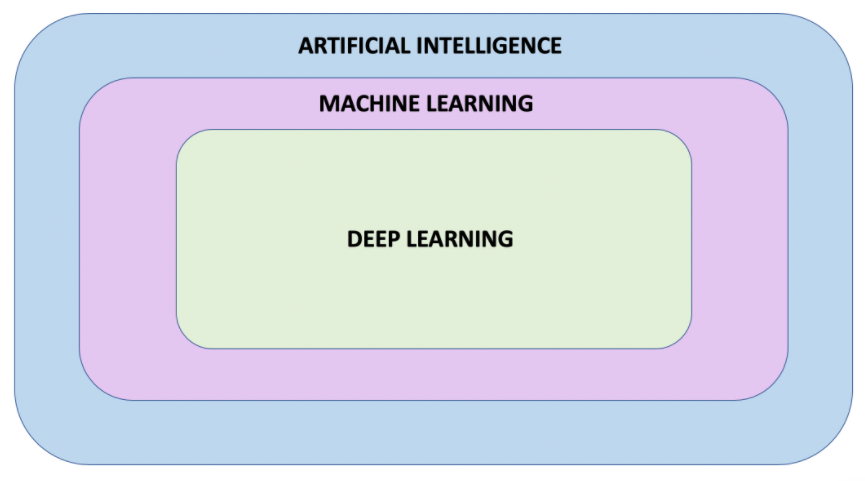
- Artificial Intelligence: A field of computer science that aims to make computers achieve human-style intelligence. There are many approaches to reaching this goal, including machine learning and deep learning.
- Machine Learning: A set of related techniques in which computers are trained to perform a particular task rather than by explicitly programming them.
- Neural Network: A construct in Machine Learning inspired by the network of neurons (nerve cells) in the biological brain. Neural networks are a fundamental part of deep learning, and will be covered in this course.
- Deep Learning: A subfield of machine learning that uses multi-layered neural networks. Often, “machine learning” and “deep learning” are used interchangeably.
- A notable example of this diversity is the separation of Supervised Learning and Unsupervised Learning.
- Supervised Learning: you know what you want to teach the computer
- Unsupervised Learning: letting the computer figure out what can be learned
- Supervised learning is the most common type of machine learning, and will be the focus of this course.
- We'll use TensorFlow and Keras. it's high-level API, and these very nicely encapsulate(요약하다) much of the complexity.
- By the end of this section, I'll have an intuitive understanding of how Deep Learning neural networks work, and I'll be able to build and train your own Deep neural network.
- In addition to Python, you can create TensorFlow models in JavaScript using TensorFlow.js
<Colab Notebook>
- Throughout this course, we will also use Google's Colab as our development environment.
- Colab is a Python development environment that runs in the browser using Google Cloud.
- To access the Colab Notebook, login to your Google account and click on the link below:
Google Colaboratory
colab.research.google.com
- Python has lists built into the language. However, we will use a library called numpy for this. Numpy gives you lots of support functions that are useful when doing Machine Learning.
- Colab is a virtual machine you can access directly. To run commands at the VM's terminal, prefix the line with an exclamation point (!).
- All usage of Colab in this course is completely free or charge. Even GPU usage is provided free of charge for some hours of usage every day.
<소스 코드>
github.com/HoYoungChun/TensorFlow_study/blob/master/01_Introduction%20to%20Colab%20and%20Python.py
HoYoungChun/TensorFlow_study
Udacity의 Intro to TensorFlow for Deep Learning 강좌 for TF_Certificate 취득 - HoYoungChun/TensorFlow_study
github.com
'인공지능(AI) > Udacity tensorflow 강의' 카테고리의 다른 글
| [Lesson 2] Your First Model: Fashion MNIST (2) (0) | 2020.09.25 |
|---|---|
| [Lesson 2] Your First Model: Fashion MNIST (1) (0) | 2020.09.25 |
| [Lesson 1] Introduction to Machine Learning (2) (0) | 2020.09.24 |
| [Lesson 1] Introduction to Machine Learning (1) (0) | 2020.09.24 |
| Intro to TensorFlow for Deep Learning (Udacity) - Syllabus (0) | 2020.09.24 |


